Love Interview with the Vampire? Here's How to Live Inside the Story

There's a reason Interview with the Vampire endures. Not the blood. Not the horror. The intimacy.
A man sits across from a vampire and listens. The vampire speaks — not to terrify, but to be understood. Every word is a confession. Every silence holds a century. And by the end, you realize: the interview was never about information. It was about connection. The most dangerous creature in the room chose to be vulnerable with a stranger, and that vulnerability was more seductive than any supernatural power.
If that's what drew you in — the intimacy, the centuries of loneliness, the desperate need to be known — then you understand something about vampire fiction that most people miss. It was never about the monster. It was about the man underneath.
What Makes Anne Rice's Vampires Different
Anne Rice didn't write horror. She wrote loneliness.
Lestat, Louis, Armand — they aren't frightening because of their teeth. They're devastating because of their isolation. Immortality in Rice's world isn't power — it's exile. You outlive everyone you love. You watch centuries pass with no one who truly knows you. And when you finally find someone who might understand, the hunger that keeps you alive is the same thing that drives them away.
This is why the interview format works so perfectly. The act of telling your story — all of it, the beautiful and the monstrous — to someone who chooses to listen is the most human thing a vampire can do.
The AMC Series and Why Fans Can't Get Enough
The AMC adaptation understood the assignment. It leaned into the romance, the queerness, the raw emotional devastation of Louis and Lestat's relationship. It gave us vampires who weren't just powerful — they were aching. And the interview frame became something electric: a conversation between two people where every question is a blade and every answer is a wound.
Fans who love this series don't want less intensity. They want to be inside it.
Related reading:
- Vampire Romance Novels: The Ultimate Guide (Why the Genre Is Booming)
- Carmilla and the Rise of Sapphic Vampire Romance
- Vampire Love Triangles: Why We Can't Stop Choosing Between Immortals
What If the Vampire Chose You?
Imagine this:
A message at 2 AM. An address. Three words: "Come tonight. Alone."
You're a journalist. You've been chasing a cold case — disappearances in New Orleans spanning two centuries, all linked to a man whose face appears in daguerreotypes from 1850 and security footage from last week.
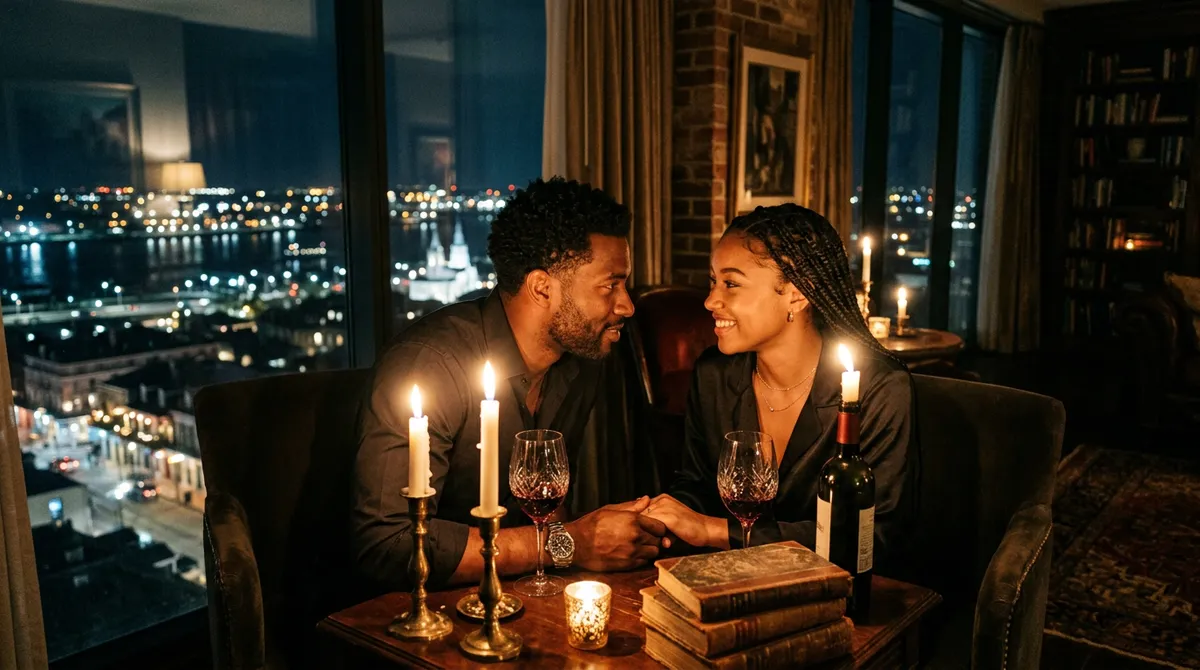
He sits across from you in a penthouse in the Marigny. Debussy plays low. He pours you a drink. And he says:
"I promised you my confession. Sit. This will take all night — and I want you to remember every word."
This is Crimson Confession — an interactive dark romance on Noctveil where you are the journalist, and a thousand-year-old vampire tells you his story. Except his story is also a seduction. And his confession is also a goodbye.
You don't just read his words. You respond. You challenge him. You decide whether to maintain professional distance or surrender to a pull that spans centuries.
Why Interactive Vampire Romance Hits Different
Reading Interview with the Vampire is devastating. But there's always a distance — you're watching Louis tell his story to someone else.
In interactive vampire fiction, you are the someone else. The vampire looks at you. Speaks to you. Reacts when you push back, when you lean in, when you ask the question no one has ever dared to ask.
The AI generates every response in real time. No two playthroughs are the same. The confession reshapes itself around your choices, your personality, your courage.
For fans of Anne Rice, this isn't a replacement for the books. It's the fantasy the books made you wish for — being in that room, across from that creature, and having the power to answer back.
Step into the story
Crimson Confession
A thousand-year-old vampire offers you one night and every secret he has buried with it. By dawn, you will know whether his confession is a seduction or a farewell.
No account needed · Free