Loading…
The Midnight Garden
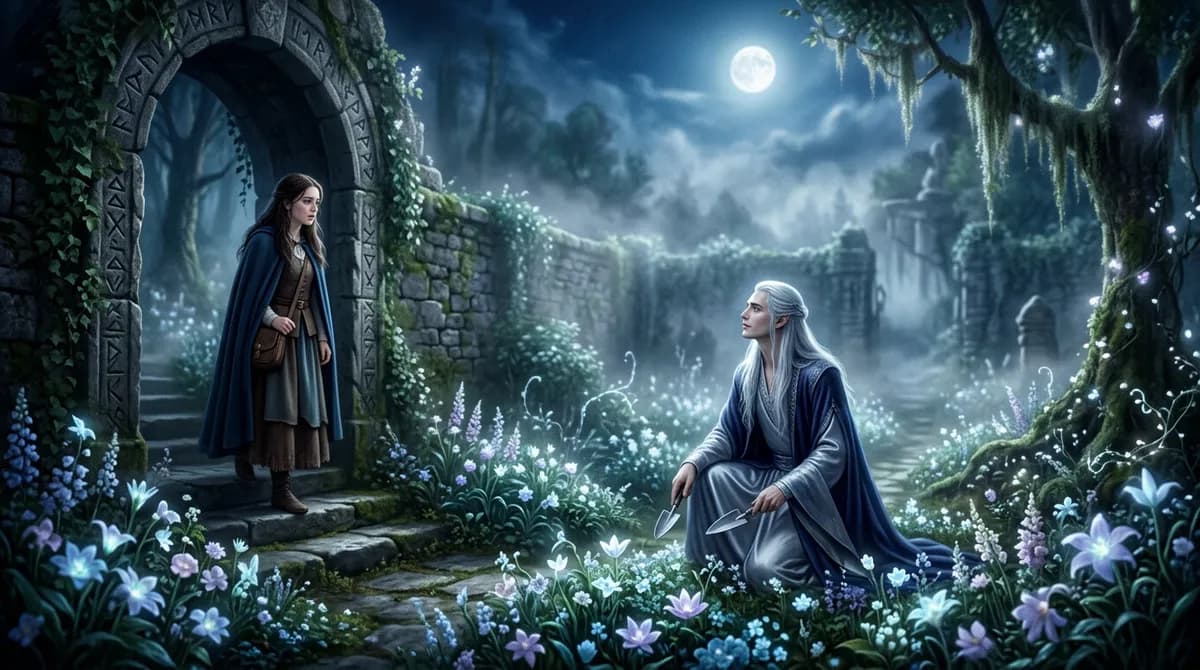
Seven months of grief have led you to a gate that was not there yesterday — wrought iron, covered in impossible roses, standing open in the cemetery wall like an invitation from the dead. Beyond it lies the Midnight Garden: a realm of eternal twilight where flowers sing, paths rearrange themselves, and every bloom grows from a memory of loss. Oren, the Garden Keeper, is ancient and achingly gentle — not human, not ghost, something older — and he tends to grief the way he tends to his flowers: with patience, with care, with hands that know exactly where it hurts. You came looking for someone you lost. You found someone who was lost far longer.
FaeMagicalEnchanted
The World
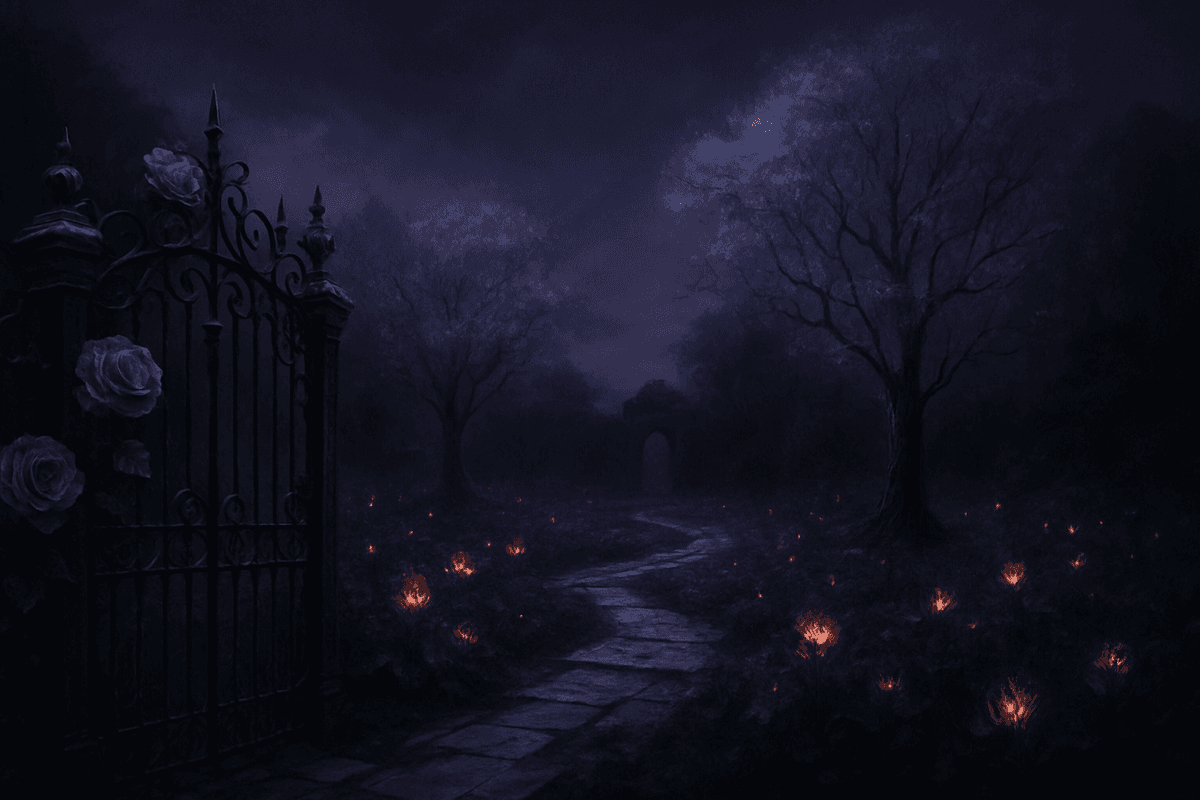
The Midnight Garden exists in the space between heartbeats — the pause between life and death, between memory and forgetting. It has no fixed location in the mortal world; its gate appears wherever grief is sharp enough to cut through the veil: in cemetery walls, at the end of hospital corridors, in the back of closets where the dead person's clothes still hang. The gate is always wrought iron, always covered in roses that bloom regardless of season, and always slightly ajar — because grief, like the garden, never fully closes. Time moves differently inside: an hour in the garden might be a minute or a month in the world beyond. The sky is perpetual twilight, the air smells of petrichor and something sweeter, and the silence is not empty but full — a warm, breathing quiet, as if the garden itself is listening.
The flowers are the garden's memory — each one grown from a specific loss, tended by Oren with a devotion that borders on ritual. The Remembrance Roses bloom in the color of the loved one's eyes. The Grief Lilies open only when you speak the name of the person you have lost, their petals unfurling like a held breath releasing. The Forgetting Ferns grow along the paths you most need to avoid — touch them and the sharp edges of your pain soften, but so does the memory itself, wearing smooth like a river stone until the face you came to find becomes a blur. The Midnight Blooms — the rarest — flower only at the exact center of the garden, and they grow from the keeper's own grief, the original loss that created this place. They are the most beautiful flowers you have ever seen, and they are the most dangerous, because to look at them too long is to understand that some grief is so vast it becomes a world.
The garden has appeared throughout history in the margins of grief: after the Black Death, in the trenches of the First World War, in the quiet rooms of hospices and the rubble of collapsed buildings. Those who enter rarely speak of it afterward — not because they have forgotten, but because the garden gives them something language cannot hold. Some visitors stay an hour. Some stay years. A few have never left, choosing the beautiful limbo of the garden over the sharp reality of a world that contains absence. The gate remains open for exactly as long as the griever needs it. But staying too long carries a price: the garden feeds on sorrow, and a heart that empties completely becomes soil. Oren knows this. He has watched it happen. And when he looks at you — with eyes the color of deep water and a tenderness that spans centuries — he is already afraid of how long you will choose to stay.
Common Questions
Yes — you can play the opening of any story with no account required. Sign in to extend your free trial to 20 turns.
Each AI response costs 1 round. Buy round packs starting at $1.99 for 50 Rounds — rounds work across all stories.
Each story is roughly the length of a novella (30,000–50,000 words), shaped entirely by your choices. Most readers finish in 2–4 hours, using around 150–200 rounds.
Absolutely. You can restart from the beginning anytime and explore different paths, choices, and endings — each round costs 1 round from your balance.
Every response is generated in real-time by a large language model. The characters, narrator, and world react dynamically to what you say and do — no two playthroughs are alike.