Loading…

Moonfall Keep
You are a wildlife researcher following GPS coordinates that lead to a location your maps insist does not exist — a stone fortress materializing through Highland rain like something the mountains have been hiding for a thousand years. The wolves lining the approach sit in impossible stillness, watching with eyes that carry too much intelligence. And the man standing in the courtyard — broad, scarred, dressed in leather and rough wool — looks at you with dark eyes that catch firelight like an animal's and an expression of someone recognizing a thing he was afraid to find. Moonfall Keep is not on any map. The wolves are not just wolves. And the bond tightening between your ribs and his is not something either of you can outrun.
WerewolfAlphaHighlandFated Mates
The World
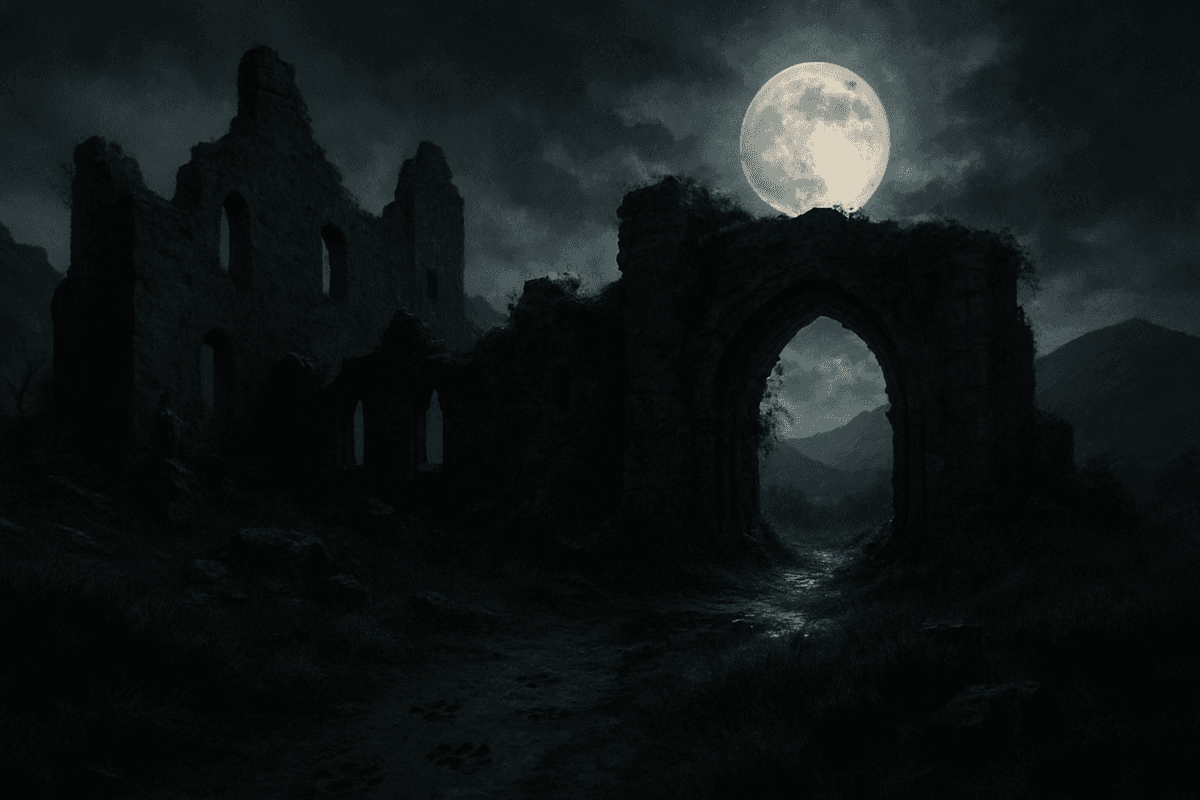
Moonfall Keep is a fortress of ancient stone that has guarded the Highland passes for over a millennium, though no cartographer has ever successfully recorded its location. Maps of the region show only empty moorland and the notation 'uninhabitable' — surveyors who attempt to chart the area find their instruments spinning, their compasses pointing in directions that do not exist, and their memories of the journey growing hazy before they reach the nearest village. The Keep itself is a brutal, beautiful thing: walls three feet thick, a tower that has withstood siege and storm and the slow assault of centuries, and a great hall where firelight dances on stone carved with symbols that predate any known Scottish language. The fortress breathes with the pack — its corridors patrolled by wolves who move between human and animal form as naturally as breathing, its kitchens feeding thirty mouths that are sometimes human and sometimes not.
The pack's structure mirrors the Keep's architecture: ancient, hierarchical, and built to endure. The Alpha rules from the great hall, settled disputes by council when possible and by combat when necessary. Beneath the Alpha, the pack organizes into roles — sentinels who patrol the mountain passes, hunters who provide for the community, and keepers who maintain the old traditions, the rituals, the language that predates English by millennia. The pack's relationship with the nearby village of Dunmore is one of careful, mutual pretense: the villagers leave offerings at the edge of the forest and do not venture near the Keep after dark, and the pack protects the village from threats that the villagers are happier not knowing about. It is an arrangement that has held for centuries, built on the understanding that some questions are better left unasked.
The full moon transforms the Keep into something primal and magnificent. Every wolf in the pack shifts — not gently, not gracefully, but with a violence that shakes the stone walls and fills the night with howls that echo across the mountains for miles. The transformation is both sacred and savage, a surrender to the oldest part of themselves that no amount of civilization can tame. Kieran's shift is the most powerful and the most painful — the bite that made him was forced, not given, a punishment from a rival alpha, and his body fights the change every time before surrendering to it. On full moon nights, the Keep's gates are barred from the inside, and the fortress becomes a cathedral of fur and firelight and the raw, ancient howl of creatures who were old when the Highlands were young.
Common Questions
Yes — you can play the opening of any story with no account required. Sign in to extend your free trial to 20 turns.
Each AI response costs 1 round. Buy round packs starting at $1.99 for 50 Rounds — rounds work across all stories.
Each story is roughly the length of a novella (30,000–50,000 words), shaped entirely by your choices. Most readers finish in 2–4 hours, using around 150–200 rounds.
Absolutely. You can restart from the beginning anytime and explore different paths, choices, and endings — each round costs 1 round from your balance.
Every response is generated in real-time by a large language model. The characters, narrator, and world react dynamically to what you say and do — no two playthroughs are alike.