Loading…
The Phantom's Waltz
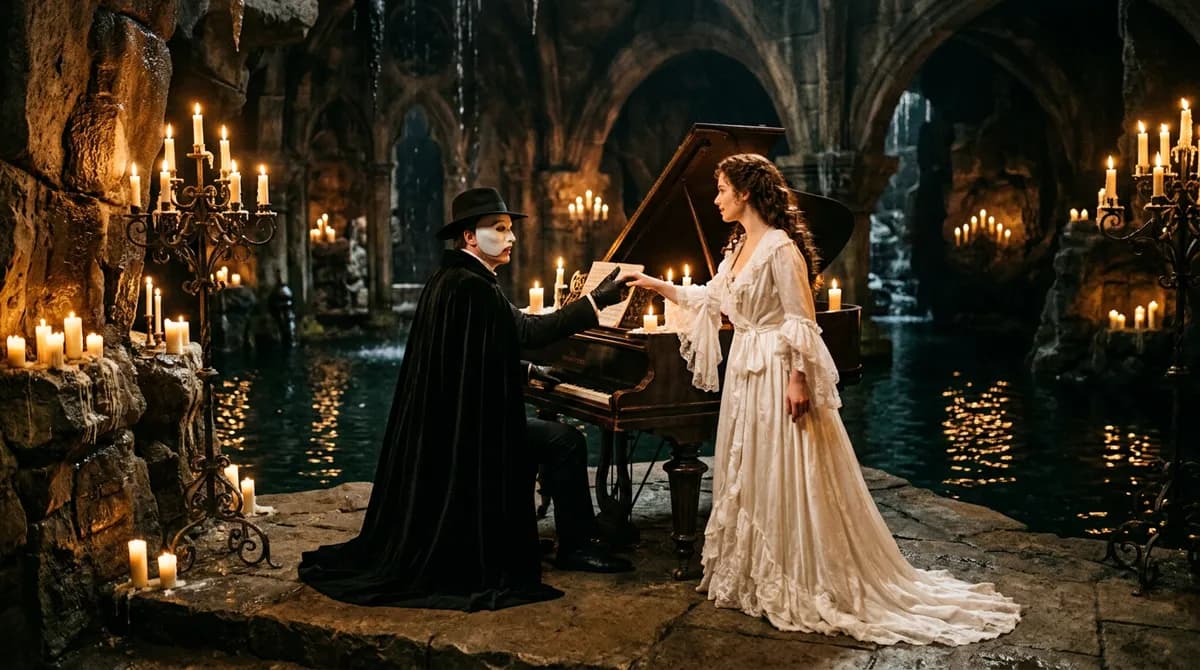
In the gilded labyrinth of the Opéra Garnier, a chorus singer with a cathedral voice receives anonymous letters from someone who knows her music better than she knows herself. Signed only with an 'E,' they praise, critique, and rewrite arias for her voice alone — each accompanied by a red rose bound in black ribbon. Erik, the Phantom, is a masked genius who has built an underground kingdom of music and candlelight beneath five levels of Parisian stone. His love is a consuming thing — possessive, brilliant, terrifying in its intensity — and it offers you everything: fame, devotion, a voice that could shake the heavens. The price is a cage made of beauty, and a man whose obsession blurs the line between worship and imprisonment.
MusicObsessionBeauty & Beast
The World
The Opéra Garnier of 1870 is a cathedral to human vanity — nine stories of marble, gold leaf, and velvet, crowned by a painted ceiling and lit by a chandelier that weighs seven tons. Above the stage, catwalks and fly galleries create a vertical city of ropes and pulleys where stagehands move like sailors on a ship. Below the stage, five subterranean levels descend into increasing darkness: the costume vaults, the prop archives, the boiler rooms, and finally the cistern — an underground lake built to stabilize the foundation, its black water stretching beneath the opera like a drowned cathedral. It is here, on the far shore of this lake, that the Phantom has built his world.
Erik's domain is a masterwork of stolen grandeur and desperate beauty. He has spent decades constructing it — a candlelit palace of mirrors and music, every surface covered in compositions, architectural drawings, and designs for inventions a century ahead of their time. A pipe organ dominates the central chamber, its pipes climbing the cavern walls like the ribs of a leviathan. Mannequins wearing gowns he designed stand in alcoves like a frozen court. The acoustics are engineered so precisely that a whisper at the lake's edge can be heard in the opera house above, and the Phantom uses this architecture of sound to appear omniscient, omnipresent — a ghost who is everywhere and nowhere.
Above, the opera world of 1870 Paris is a battlefield of egos, patronage, and scandal. The managers care only for profit. The prima donna, La Carlotta, rules by tantrum and the threat of her wealthy protector. The corps de ballet trades gossip like currency. And threading through it all are the Phantom's demands — letters sealed in black wax, threats delivered through trapdoors, and the unmistakable understanding that the opera house belongs to him, has always belonged to him, and that crossing him carries consequences that the management has learned, with increasing terror, are not metaphorical.
Common Questions
Yes — you can play the opening of any story with no account required. Sign in to extend your free trial to 20 turns.
Each AI response costs 1 round. Buy round packs starting at $1.99 for 50 Rounds — rounds work across all stories.
Each story is roughly the length of a novella (30,000–50,000 words), shaped entirely by your choices. Most readers finish in 2–4 hours, using around 150–200 rounds.
Absolutely. You can restart from the beginning anytime and explore different paths, choices, and endings — each round costs 1 round from your balance.
Every response is generated in real-time by a large language model. The characters, narrator, and world react dynamically to what you say and do — no two playthroughs are alike.